 Written By Katherine Lanphear L’27
The Case
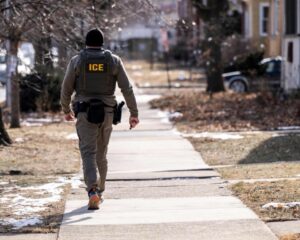
On September 8th, 2025, the Supreme Court solidified its support for ICE’s use of racial profiling in Noem v. Perdomo.[1] This case concerns immigration raids conducted by Immigrations and Customs Enforcement, Department of Homeland Security, and other federal agencies in the Los Angeles area, coming as a part of “Operation at Large,” a widespread immigration enforcement plan put forth by the Trump administration.[2] As swaths of federal agents appeared in Los Angeles in the summer of 2025, they began to show up at businesses and public places, stopping, frisking, and detaining individuals suspected of being in the United States illegally.[3]
Plaintiffs sued seeking emergency relief from the District Court for the Central District of California to block these stops and detentions, alleging they were conducted without reasonable suspicion- a violation of the Fourth Amendment.[4] The District Court granted Plaintiffs their remedy: a temporary restraining order against the federal government.[5] However, the government appealed, and the Supreme Court heard the case as part of their shadow docket: a separate fast-track, often reserved for emergency decisions and injunctions, coming with little to no legal reasoning.[6]
In staying the lower court’s restraining order, the Court once again permitted agents to stop and arrest people based on their race or ethnicity, place of work, place of residence, and language or accent.[7] While the majority opinion provides no rationale for the decision, Justice Kavanaugh’s lengthy concurrence intertwines a reading of precedent with a heavy reliance on “common sense”, an ill-defined supporting catch-all.[8]
The Precedent
The court relies on precedent set in Brignoni-Ponce, which echoes earlier criminal procedure cases like Terry v. Ohio and Adams v. Williams in holding that a reasonable articulable suspicion is required to make a stop.[9] With regard to immigration proceedings, an officer possesses reasonable articulable suspicion “only if they are aware of specific articulable facts, together with rational inferences from those facts, that reasonably warrant suspicion” that the individual “may be illegally in the country.”[10] This standard requires more than unparticularized suspicion or a hunch that there may be criminal activity, but rests below a preponderance.[11]
Notably, the holding in Brignoni was not favorable to the immigration procedure at issue.[12] There, the court held that the reliance placed on Mexican descent was not sufficient to support reasonable articulable suspicion.[13] “[Hispanic appearance] alone would justify neither a reasonable belief that they were aliens, nor a reasonable belief that the car concealed other aliens who were illegally in the country. Large numbers of native-born and naturalized citizens have the physical characteristics identified with Mexican ancestry, and even in the border area a relatively small proportion of them are aliens.”[14] Five years earlier, the court laid a solid foundation for this rationale in Reid v. Georgia, noting that a characteristic relied on for reasonable suspicion cannot “describe a very large category of presumably innocent” people.[15]
Here, Justice Kavanaugh’s concurrence attempts to differentiate the case at bar, finding that, while latino appearance is a major factor, suspicion is a context heavy pursuit and officers also consider gathering in locations for day labor, and speaking a non-english language or having an accent, among others.[16] In LA County, 48.8% of individuals are of latino or hispanic descent, while 55% speak a language other than English at home.[17] Applying Reid, it would seem that latino appearance and non-english language or accent are both characteristics that describe a very large category of presumably innocent people. And yet, the Court stayed the restraining order, finding that these characteristics were sufficient to support a reasonable suspicion for a stop and frisk.[18]
Importantly, the court must also engage in a balancing test when government action against the people is concerned- weighing the harms to impacted individuals.[19] Here, the court weighs the harms against improperly stopped US citizens and “properly” stopped non-citizens if the measure goes forward against the harms to the government and third parties if the measure does not go forward.[20] The Justice is clear in his reasoning- the interest of non-citizens is that of succeeding in legal evasion- not a weighty interest to the court.[21] Those who are permitted to be in the country however, have a similarly low interest: “ As …for stops of those individuals who are legally in the country, the questioning in those circumstances is typically brief, and those individuals may promptly go free after making clear to the immigration officers that they are U.S. citizens or otherwise lawfully in the United States.”[22] There are two issues with this statement.
First, as the dissent points out, the concurrence engages in an unexplained burden shifting: it has historically rested on the government to prove that it has reasonable suspicion to perform a stop.[23] Here, Justice Kavanaugh shifts that burden onto the citizen, implicitly requiring that they carry enough documentation to prove to agents that they ought to be allowed to go free.[24] Seemingly without thought, the Justice places a very high burden of continued documentation onto all U.S. Citizens who happen to appear latino, speak Spanish, and/or perform day labor, among other things.
Second, the plaintiffs in this case are, in fact, U.S. citizens. As such, the concurrence would place them into the category of those whose “questioning is typically brief.”[25] In actuality, one plaintiff was pushed against a fence with his arms twisted behind his back, while another was removed from his job site to an unknown warehouse for further questioning.[26] This is to say nothing of the more than 170 U.S. citizens who have been, among other things, “dragged, tackled, beaten, tased, shot, detained for days, and [had] property destroyed,” before being released because they eventually proved their burden.[27]
The Implication
The partisan nature of the modern Court is no secret– recent decisions have indicated clear support for conservative policies, while dissents have indicated a clear rejection of those policies by more liberal justices. This case, however, seems a clearer marker than any that the Court will attempt to rationalize the Trump administration’s crackdowns on immigration with the constitution and its own precedent. The administration has continued to push the bill, with DHS officials encouraging agents to “push the envelope” and “turn the creative knob up to 11” when it comes to enforcement.[28]
Since the beginning of the second Trump administration, changes in “at-large” arrest practices have led to a 2,450% increase in the number of individuals with no criminal record being held in ICE detention on any given day.[29] The numbers of detained individuals are only rising as these measures continue, and with the windfall of this Court signaling its support for their practices, there is no telling to what heights they will climb. Whether one falls left or right of the political aisle, it is important to watch these decisions and rationales with a keen eye on the constitution and hold fast to our bearings as a country and a people.
—
[1] Noem v. Vasquez Perdomo, 222 L. Ed. 2d 1213 (2025) (KAVANAUGH, J., concurring) (slip op., at 4).
[2] Id. ; Julia Ainsely et. al, A Sweeping New ICE Operation Show How Trump’s Focus on Immigration is Reshaping Federal Law , NBC (June 4, 2025) NewsEnforcmenthttps://www.nbcnews.com/politics/justice-department/ice-operation-trump-focus-immigration-reshape-federal-law-enforcement-rcna193494.
[3] Id.
[4] Noem v. Vasquez Perdomo, 222 L. Ed. 2d 1213 (2025) (KAVANAUGH, J., concurring) (slip op., at 4); The 4th amendment to the Constitution protects “the right of the people to be secure in their persons, houses, papers, and effects, against unreasonable searches and seizures” and prevents generalized, non-specific warrants.
[5] Noem v. Vasquez Perdomo, 222 L. Ed. 2d 1213 (2025) (KAVANAUGH, J., concurring) (slip op., at 4)
[6]Rachel Reed, Shedding Light on the Supreme Court’s Shadow Docket, Harvard Law Today (Mar. 04, 2026), https://hls.harvard.edu/today/shedding-light-on-the-supreme-courts-shadow-docket/.
[7] Noem v. Vasquez Perdomo, 222 L. Ed. 2d 1213 (2025) (KAVANAUGH, J., concurring) (slip op., at 6)
[8] Id. at 3.
[9] U.S. v. Brignoni-Ponce, 422 U.S. 873 (1975); Terry v. Ohio, 391 U.S. 1 (1968); Adams v. Williams, 407 U.S. 143 (1972).
[10] Brignoni at 885.
[11] Noem v. Vasquez Perdomo, (SOTOMAYOR, S., dissenting) (slip op., at 10 )(quoting Illinois v. Wardlow, 528 U.S. 119 at 123).
[12] See generally Brignoni-Ponce.
[13] Id.
[14] Brignoni-Ponce at 887.
[15] Reid v. Georgia, 448 U.S. 438 (1980).
[16] Noem v. Vasquez Perdomo, (KAVANAUGH, J., concurring) (slip op., at 3).
[17] United States Census Bureau, Los Angeles County, California (2025).
[18] Noem v. Vasquez Perdomo, (KAVANAUGH, J., concurring).
[19] Id. at 7.
[20] Id. at 8.
[21] Id. at 8-9.
[22] Id. at 6.
[23] Noem v. Vasquez Perdomo, (SOTOMAYOR, E., dissenting)(slip op., at 20).
[24] Id.
[25] Id. at 16-17.
[26] Id.
[27] Nicole Foy, We Found That More Than 170 U.S. Citizens Have Been Held by Immigration Agents, Propublica (Oct. 16, 2025), https://www.propublica.org/article/immigration-dhs-american-citizens-arrested-detained-against-will.
[28]José Olivares, US Immigration Officers Ordered to Arrest More People Even Without Warrants, The Guardian (Jun 4, 2025) https://www.theguardian.com/us-news/2025/jun/04/immigration-officials-increased-detentions-collateral-arrests.
[29] Aaron Reichlin-Melnick, New Report Details ICE’s Expanding and Increasingly Unaccountable Detention System (Jan. 23 2026) https://www.americanimmigrationcouncil.org/blog/ice-expanding-detention-system/.