
Written By Maddie Walker L’27
The landscape of civil rights and constitutional guarantees looks very different in 2026 than it did even a few years ago. While much legal scholarship exists to explain the judicial narrowing of civil rights in recent years,[1] an often underrepresented concept comes from the rise of originalist ideology through the legal pipeline. Originalism itself is an ambiguous term with a number of differing ideological branches, but, for the purposes of this article, I will focus on the legal constitutional interpretation that prioritizes the original public meaning of the Constitution at the time it was written.[2] The original public meaning of a constitutional text is an objective legal construct like the “reasonable man” standard in tort law, which judges a person’s actions based on whether an ordinary person would consider them reasonable, given the situation.[3] It exists independently of the subjective “intentions” of those who wrote the text or of the “original expected applications” that the Framers of a constitutional text thought that it would have.[4]
Original public meaning originalism has faced heavy scrutiny since its inception.[5] This is largely because it seemed to appear out of nowhere in the 1970s and 1980s as conservative critics reacted to the decisions of the Warren Court and the Reagan Administration embraced originalism as a check on judicial activism.[6] Originalism hasn’t been possible until the past few decades due to the development of technology and databases that help lawyers look back in time to newspapers, dictionaries, and other relevant interpretive documents to discern what they believe to be the original public meaning of the Constitution.[7]
The relative newness of this interpretive methodology has taken the constitutional world by storm. Recent landmark Supreme Court cases decided through originalist framework have suddenly overturned longstanding precedent and restricted preexisting civil rights.[8] Originalism exists and is able to strip away rights today due to the dramatic widening of the Overton Window in recent years, which models how previously fringe constitutional arguments can become accepted as mainstream legal reasoning through the expansion of positive public opinion.[9]
The Overton Window, a term coined by the late Joseph P. Overton, was developed in the mid-1990s and is a model for understanding how ideas in society change over time and influence politics.[10] The core concept is that politicians are limited in what policy ideas they can support – they generally only pursue policies that are widely accepted throughout society as legitimate policy options.[11] These policies lie within the Overton Window.[12] Other policy ideas exist, but politicians risk losing popular support if they champion these ideas.[13] These policies lie outside the Overton Window.[14] I argue that the expansion, rather than mere shifting, of acceptable ideologies within the Overton Window, particularly originalism, is due in large part to the rise of conservative legal groups and social media.
The Rise of an Originalist Court
Original public meaning originalism, as a concept, followed in the footsteps of the founding of the Federalist Society in 1982,[15] which promoted the “great debate” over originalism between prominent legal scholars such as Attorney General Edwin Meese, Judge Robert Bork, Justice William Brennan, and John Paul Stevens.[16] Given this history, it is no surprise that concerns about originalism were a prominent theme in the debate over the nomination of Robert Bork to the U.S. Supreme Court in 1987.[17] The Reagan era was also a time for active academic debate over the intellectual merits of originalism.[18] By the time Robert Bork and Antonin Scalia published their book-length defenses of originalism, their views were both familiar and well mooted in the literature.[19] The political salience of originalism undoubtedly boosted academic interest in the theory, but the period was also a fertile time for such theoretical debates.[20] Scholarly debates revolved around competing “grand constitutional theories” concerned with justifying and guiding the exercise of judicial review.[21] The Federalist Society has remained an architect for originalism, creating pipelines for law students around the country to be placed in legal jobs, clerkships, and judgeships.[22]
Though a number of legal scholars had become amicable to the idea of original public meaning originalism, it remained a fringe interpretation of the Constitution until Justice Antonin Scalia gradually adopted the conservative interpretation during his Supreme Court tenure from 1986 to 2016.[23] After Justice Scalia’s death, he was replaced by Justice Neil Gorsuch, a self-proclaimed disciple of Justice Scalia’s originalist crusade.[24] He was soon followed by Justices Brett Kavanaugh and Amy Coney Barrett, who both proclaimed originalist views of the Constitution.[25] The three Justices now join Justice Clarence Thomas as strong originalists on the Court,[26] and Chief Justice John Roberts, who, in his confirmation hearings, described himself not as an originalist, but as someone who respects stare decisis over original public meaning.[27] Even though he has never raised the originalist banner, he has been behind some of the most infamous recent originalist opinions of the court.[28] Every Supreme Court Justice mentioned above in this paragraph has ties to the Federalist Society.[29] Even liberal Justices Elena Kagan and Ketanji Brown Jackson embrace the use of progressive originalism.[30] Though originalism isn’t necessarily the only interpretive theory that a judge may use, they have the liberty to decide whether to use the same theory or change it from case to case, unlike attorneys who often argue whichever theory a judge is partial to.[31] Originalism, as a preferred methodology, commands a majority on the Supreme Court for the first time in history.[32]
Social Media
The evolution of social media not only changed how we access news and information – it shifted who provides it to us.[33] Professional news organizations are certainly active on social media, but they are a very small group of voices amongst the 5.66 billion[34] social media accounts worldwide.[35] At least by sheer volume, social media “news” is provided primarily by individuals, not professional news organizations.[36]
Algorithm-driven social media networks aim to keep the user on the platform as long as possible; to that end, each network has developed its own algorithm, which analyzes a user’s past interaction history and presents them with new content the user may also enjoy, thus encouraging the user to spend more time on the platform.[37] Business models reward provocative videos and controversial claims with exposure in advertising dollars.[38] They provide algorithms that guide users down personalized paths meant to keep them glued to their screens.[39] This type of algorithm has been heavily influential to the ever-increasing partisan divide facing the general public and, more specifically, legal scholars today.[40]
The amplification of once radical constitutional interpretations has shifted public perception about what interpretations are legitimate.[41] Ideas that once existed primarily in academic or fringe legal circles have gained mass visibility. Social media does not create constitutional movements, but it accelerates the normalization of ideas that shift, and, recently, expand the Overton Window.[42] Though originalist ideology would likely have ended up before the Court eventually, online feedback loops certainly brought it there faster.
Civil Rights Going Forward
Originalism may colloquially be seen as a tool for the contraction of rights, but it also often serves to expand certain firearm and religious rights.[43] Those rights, according to originalists, reflect what the public believed the First and Second Amendments meant at the time they were ratified.[44] However, the general public still frowned upon mixed-race relationships and interracial marriage, among many other now landmark civil rights, when the Fourteenth Amendment was ratified in 1868.[45] With the strong originalist makeup of the current Supreme Court, it is fair to question whether rights engrained in our modern society are in danger of being contracted.
Perhaps the proverbial canary in the coal mine for potential future civil rights narrowing remains Justice Thomas’s concurrence in Dobbs v. Jackson Women’s Health Org. (2022), a notorious originalist case, in which he claims that cases like Griswold v. Connecticut, 381 U.S. 479 (1965) (right of married persons to obtain contraceptives), Lawrence v. Texas, 539 U.S. 558 (2003) (right to engage in private, consensual sexual acts), and Obergefell v. Hodges, 576 U.S. 644 (2015) (right to same-sex marriage) should be reconsidered.[46] Thomas has been a long-time critic of substantive due process, which is the principle that the Fifth and Fourteenth Amendments of the Constitution protect fundamental rights from government interference.[47] Specifically, the Fifth and Fourteenth Amendments prohibit the government from depriving any person of “life, liberty, or property without due process of law.”[48] The Fifth Amendment applies to federal action, and the Fourteenth Amendment applies to state action.[49]
Thomas, in his Dobbs concurrence, bluntly states that “at most the Due Process Clause guarantees process.”[50] He points out how historical evidence shows that “due process of law merely required executive and judicial actors to comply with legislative enactments and the common law when depriving a person of life, liberty, or property.”[51] Based on Thomas’s analysis, the Court has no business creating new fundamental rights under the guise of Due Process, including a right to abortion.[52] Thomas further suggests that the Court should at a later time reevaluate the Fourteenth Amendment substantive due process jurisprudence due to the fact that “any Substantive due process decision is demonstrably erroneous.”[53]
Currently on the Supreme Court’s docket are cases on the legality of birthright citizenship through the Citizenship Clause of the Fourteenth Amendment,[54] and whether the Equal Protections Clause of the Fourteenth Amendment allows for the banning of transgender athletes in high school[55] and university sports teams.[56] Each of these cases were legally and politically outside of the Overton Window until this Supreme Court term. Needless to say, these are all likely to be landmark cases in regard to the Fourteenth Amendment. The Supreme Court usually issues all of their decisions by the end of June before they go on recess, but we do not yet know what the last day of the current term will be. Given the gravity of these cases, they will likely be handed down towards the end of the term.
Considering the originalist makeup of the Court and its willingness to even grant certiorari in the first place, we could very well see a stripping back of trans rights and perhaps the complete destruction of birthright citizenship this term, among plenty of other possible landmark originalist decisions. The Court has historically gone through periods of expanding and retracting rights,[57] but we are currently witnessing one of the most conservative Supreme Courts in history.[58] The Court has produced more conservative decisions this term than at any time since 1931, according to statistics compiled by professors Lee Epstein of Washington University in St. Louis and Keven Quinn of the University of Michigan.[59] Originalist legal reasoning has had a hefty hand in those statistics.
The implications of these cases are vast. Excluding transgender women from sports teams invites gender policing that could subject any woman to invasive tests or accusations of being “too masculine” or “too good” at their sport to be a “real” woman.[60] Excluding transgender girls on the basis of their supposed advantages, while ignoring the wide varieties of body types and physical ability among all women, is both discriminatory to transgender girls and relies on very old stereotypes of women as inherently petite and weak.[61]
Should birthright citizenship be taken away, babies born in the U.S. to non-citizen parents who are temporarily or lawfully present — including legal visa holders, DACA recipients, and those with humanitarian protections — would no longer be considered citizens at birth.[62] These babies would be left in legal limbo, creating a permanent, multi-generational subclass denied citizenship, legal identity, and basic protections.[63] Children could face arrest and deportation even though their parents, such as someone living in the U.S. legally on a work visa, might be allowed to remain lawfully in the country.[64]
Among other Court-watchers, Jason Mazzone, Professor of Law at the University of Illinois at Urbana-Champaign, expects that the birthright citizenship case will result in a strongly originalist opinion that deploys constitutional text, structure and history to reject the President’s attempt to evade the plain words of the Fourteenth Amendment.[65] In his words, what “a fitting outcome in the year in which we celebrate the 250th anniversary of the Declaration of Independence.”[66]
—
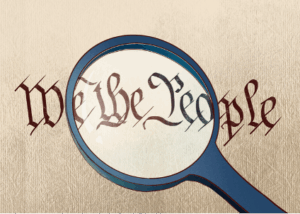
Photo Citation: Catherine H. Feng, Illustration of the Constitution in The Harv. Crimson (2025), https://www.thecrimson.com/image/2025/10/6/constitution-graphic/.
[1] See, e.g., Richard M. Re, Narrowing Precedent in the Supreme Court, 114 Colum. L. Rev. 1861–1911 (2014); John Valery White, Civil Rights Equity: An Introduction to a Theory of What Civil Rights Has Become, 78 Wash. & Lee L. Rev. 1889 (2022); and William L. Taylor et al., The Erosion of Rights: Declining Civil Rights Enforcement Under the Bush Administration, Ctr. for Am. Progress (Mar. 21, 2007).
[2] Lawrence B. Solum, What is Originalism? The Evolution of Contemporary Originalist Theory, Geo. Univ. Law Ctr. 2-6 (2011), https://scholarship.law.georgetown.edu/cgi/viewcontent.cgi?article=2362&context=facpub.
[3] Steven G. Calabresi, On Originalism in Constitutional Interpretation, Nat’l Const. Ctr., https://constitutioncenter.org/the-constitution/white-papers/on-originalism-in-constitutional-interpretation.
[4] Id.
[5] See, e.g., Jack M. Beermann, The Immorality of Originalism, 72 Cath. Univ. L. Rev. 445 (2023); Richard H. Fallon, Jr., Selective Originalism and Judicial Role Morality, 102 Tex. L. Rev. 221 (2023); and Mitchell N. Berman, Originalism is Bunk, 84 N.Y.U. L. Rev. 1 (2009).
[6] Keith E. Whittington, Originalism: A Critical Introduction, 82 Fordham L. Rev. 375, 375 (2013).
[7] Eric L. Muller, Originalism Was Impossible, The Atlantic (Sept. 24, 2024), https://www.theatlantic.com/ideas/archive/2024/09/originalism-was-impossible/679996/.
[8] See, e.g., Loper Bright Enters. v. Raimondo, 603 U.S. 369 (2024) (overturning the Chevron doctrine); Students for Fair Admissions, Inc. v. Pres. and Fellows of Harv. Coll., 600 U.S. 181 (2023) (effectively overturning decades of precedent allowing race-conscious college admissions); and Dobbs v. Jackson Women’s Health Org., 597 U.S. 215 (2022) (overturning cases that decided that the implied right to privacy included the right to an abortion).
[9] Sophia Decherney, Overton Window of Political Possibility, Britannica (May. 20, 2025), https://www.britannica.com/topic/Overton-window.
[10] A Brief Explanation of the Overton Window, Mackinac Ctr. for Pub. Pol’y, https://www.mackinac.org/overtonwindow.
[11] Id.
[12] Id.
[13] Id.
[14] Id.
[15] About Us, Federalist Soc’y, https://fedsoc.org/about-us.
[16] Whittington supra note 7, at 376.
[17] Id.
[18] Id.
[19] Id.
[20] Id.
[21] Id.
[22] Emma Green, How the Federalist Society Won, The New Yorker (July 24, 2022), https://www.newyorker.com/news/annals-of-education/how-the-federalist-society-won.
[23] Jeff Neal, Was Antonin Scalia Originally an Originalist?, Harv. law Today (Oct. 26, 2022), https://hls.harvard.edu/today/was-antonin-scalia-originally-an-originalist/#:~:text=Harvard%20Law%20Professor%20Adrian%20Vermeule,Tyler%2C%20Jr.; Scalia, Antonin, Fed. Jud. Ctr., https://www.fjc.gov/history/judges/scalia-antonin.
[24] Lauren Russell and Nina Totenberg, Trump’s Supreme Court Pick is a Disciple of Scalia’s ‘Originalist’ Crusade, Nat’l Pub. Radio (Feb. 2, 2017), https://www.npr.org/2017/02/02/512891485/trumps-supreme-court-pick-is-a-disciple-of-scalias-originalist-crusade.
[25] Brian Naylor, Barrett, An Originalist, Says Meaning of Constitution ‘Doesn’t Change Over Time’, Nat’l Pub. Radio (Oct. 13, 2020), https://www.npr.org/sections/live-amy-coney-barrett-supreme-court-confirmation/2020/10/13/923215778/barrett-an-originalist-says-meaning-of-constitution-doesn-t-change-over-time.
[26] William H. Pryor, Jr., Justice Thomas, Criminal Justice, and Originalism’s Legitimacy, 127 Yale L. J. Forum 173, 174 (2017).
[27] Jeffrey Rosen, Originalism, Precedent, and Judicial Restraint, 34 Harv. J. L. & Pub. Policy 129, 130 (2011).
[28] See, e.g., Loper Bright Enters., 603 U.S..; U.S. v. Rahimi, 602 U.S. 680 (2024).
[29] The Conservative Club That Came to Domainate the Supreme Court, Harv. Gazette (Mar. 4, 2021), https://news.harvard.edu/gazette/story/2021/03/in-audiobook-takeover-noah-feldman-lidia-jean-kott-explore-how-federalist-society-captured-supreme-court/.
[30] Josh Gerstein, Kagan Hopes Supreme Court’s Ideological Divide on Precedent Isn’t Permanent, Politico (Sept. 22, 2023), https://www.politico.com/news/2023/09/22/elena-kagan-supreme-court-precedent-speech-00117760; Mark Joseph Stern, Ketanji Brown Jackson Has Perfected the Art of Originalism Jujitsu, Const. Accountability Ctr. (July 28, 2023), https://www.theusconstitution.org/news/ketanji-brown-jackson-has-perfected-the-art-of-originalism-jujitsu/.
[31] Alexander Volokh, Choosing Interpretive Methods: A Positive Theory of Judges and Everyone Else, NYU L. Rev. 769, 769 (Aug. 31, 2007).
[32] Jonathan Gienapp, Why is the Supreme Court Obsessed with Originalism?, Yale Univ. Press (Oct. 21, 2024), https://yalebooks.yale.edu/2024/10/21/why-is-the-supreme-court-obsessed-with-originalism/.
[33] Zachary R. Cormier, Actual Malice Originalism: A Press Function Solution to Social Media Concerns, 76 Baylor L. Rev, 303, 306 (2024).
[34] Global Social Media Statistics, DataReportal (2025), https://datareportal.com/social-media-users/.
[35] Cormier supra note 34, at 307.
[36] Id.
[37] Pilar Mae Hoye, Down the Alt-Right Rabbit Hole: The Rise of Social Media Platforms in the Radicalization of Domestic Right-Wing Terrorists, 33 S. Cal. Interdisc. L. J. 161, 162 (2023).
[38] Kevin Roose, The Making of a Youtube Radical, N.Y. Times (June 8, 2019), https://www.nytimes.com/interactive/2019/06/08/technology/youtube-radical.html.
[39] Id.
[40] Id.
[41] Sabrina Mori, Algorithmic Amplification: How Social Media Algorithms Shape Us, Univ. of Tex. ScholarWorks 1, 10 (2025), https://repositories.lib.utexas.edu/items/bdcc62ca-9b68-4e65-8775-e5f06c59a655.
[42] James P. Walsh, Social Media and Moral Panics: Assessing the Effects of Technological Change on Societal Reaction, Nat’l Libr. of Med. (Mar. 28, 2020)
[43] See, e.g., D.C. v. Heller, 554 U.S. 570 (2008) (ruling that handguns may be possessed in the home); New York State Rifle & Pistol Ass’n, Inc. v. Bruen, 597 U.S. 1 (2022) (ruling that individuals have a right to carry a handgun for self-defense outside of the home); and Kennedy v. Bremerton Sch. Dist., 597 U.S. 507 (2022) (ruling that an employee’s private religious exercise was not impermissible government coercion of students to pray).
[44] Jill Filipovic, Originalism Is One Reason Why America Has Such a Gun Problem, Slate (May 8, 2024), https://slate.com/news-and-politics/2024/05/american-gun-problems-originalism-scotus.html?pay=1774314731720&support_journalism=please.
[45] Nyla Provost, Mixing: A History of Anti-Miscegenation Laws in the United States, 16 Hist. in the Making 75, 77 (2023).
[46] Dobbs, 597 U.S. at 331 (Thomas, J., concurring).
[47] Substantive Due Process, Cornell Law Sch., https://www.law.cornell.edu/wex/substantive_due_process.
[48] Id.
[49] Id.
[50] Dobbs, 597 U.S. at 331 (Thomas, J., concurring).
[51] Id.
[52] Justice Thomas Takes on “Substantive Due Process” Doctrine in Dobbs, Founding Freedoms Law Ctr. (July 12, 2022), https://www.foundingfreedomslaw.org/legal-blog/justice-thomas-addresses-substantive-due-process#:~:text=Justice%20Thomas%20questions%20the%20idea%20that%20the,Substantive%20due%20process%20decision%20is%20demonstrably%20erroneous.%E2%80%9D.
[53] Id.
[54] Trump v. Barbara, No. 25-365, 2025 WL 3493157 (U.S. Dec. 5, 2025).
[55] W.V. v. B.P.J., No. 24-43 (U.S. argued Jan. 13, 2026).
[56] Little v. Hecox, No. 24-38 (U.S., argued Jan. 13, 2026).
[57] Supreme Court History, Justia, https://supreme.justia.com/supreme-court-history/.
[58] Conservative Victories at the Supreme Court, Senate RPC (Aug. 4, 2022), https://www.rpc.senate.gov/policy-papers/conservative-victories-at-the-supreme-court.
[59] Nina Totenberg, The Supreme Court is the Most Conservative in 90 Years, NPR (July 5, 2022), https://www.npr.org/2022/07/05/1109444617/the-supreme-court-conservative.
[60] West Virginia v. B.P.J.: What’s At Stake, ACLU, https://www.aclu.org/cases/bpj-v-west-virginia-state-board-education.
[61] Id.
[62] Barbara v. Donald J. Trump: What’s At Stake, ACLU, https://www.aclu.org/cases/barbara-v-donald-j-trump.
[63] Id.
[64] Id.
[65] Jeff D’Alessio, Experts Offer Predictions on Illini, Supreme Court, Durbin’s Senate Seat, Oscars and More, The News-Gazette (Jan. 3, 2026).
[66] Id.