
Written By Daisy Holder L’27
The Sixth Amendment guarantees the right to a public jury trial.[1] The jury trial requires the government to prove its case beyond a reasonable doubt before members of the community, promoting transparency, legitimacy, accountability, and justice.[2] Despite the value of both bench and jury trials, the American system has developed in ways that discourage defendants from asserting these rights. Today, over 95% of criminal cases are resolved through guilty pleas and without trials.[3] While many factors contribute to this issue, one such factor is the trial penalty. The trial penalty refers to the differential between the plea offered and the sentence that a defendant actually receives after trial.[4] In federal felony cases, for example, sentences after trial exceed those after pleas by an average of seven years[5]. In drug trafficking cases: nine.[6] No difference in penalties would reduce incentives for defendants to engage in plea bargaining; however, too wide a gap becomes coercive.[7] When a defendant is confronted with a reduced sentence contingent on a guilty plea or the risk of a substantially harsher sentence after trial, the purported choice between these options becomes largely illusory.
The trial penalty has two primary catalysts: mandatory minimums and sentencing guidelines.[8] Mandatory minimums remove judicial discretion from sentencing and effectively transfer control to the prosecutor, who decides what offense to charge and thus what sentence the accused receives if convicted.[9] With control over both charges and sentences, prosecutors wield immense leverage over defendants. Prosecutors routinely overcharge offenses to gain leverage in plea bargaining.[10] The existence of mandatory minimums exacerbates this leverage, giving the prosecutor the ability to charge a defendant with an offense carrying a mandatory minimum if they refuse to accept the plea offer.[11] Both prosecutors and defense attorneys confirm that mandatory minimum sentences are routinely used to coerce defendants into pleading.[12]
The “choice” is clear: try the case and risk a mandatory minimum, or accept the prosecution’s lesser charge offer.
While on their face the guidelines reduce sentencing disparities, they can be manipulated in much the same way that mandatory minimum sentences can.[13] As those in control of the charges and facts, prosecutors can shape the application of the sentencing guidelines, and in turn, the resulting punishment. Since sentencing guideline calculations depend on the offenses charged and factual findings, prosecutors can effectively steer the guideline range and resulting sentence.[14] Again, prosecutors possess significant leverage that, when wielded improperly, undermines the defendant’s ability to make a voluntary choice.
The trial penalty presents a host of issues that highlight the importance and function of trials in the criminal legal system. Firstly, the innocence problem. The Innocence Project reports that 15% of people who have been exonerated took a guilty plea.[15] This means that innocent people are pleading guilty for reasons other than guilt. The role of the trial penalty here is clear: the threat of a higher sentence after trial creates pressure that can induce even innocent people to plead guilty. Also at issue is the degradation of lawyer skills and the common law system. Without the check of trials, prosecutors could pursue weak cases knowing that the evidence and their witnesses will not be challenged.[16] Similarly, defense attorneys would have fewer opportunities to develop trial skills and assess the strength of cases. Beyond that, the common law system itself would atrophy. Trials provide factual and legal records to be reviewed in appellate courts.[17] Without trials, there would be minimal factual or legal records to review. Further, defendants typically waive several rights when they enter a guilty plea, one such right being the right to challenge unlawfully obtained evidence.[18] A system dominated by guilty pleas significantly limits the development of common law, given the lack of cases addressing contested criminal legal issues.
Not only would appellate review diminish, but so would review of police activity. Because so many cases are resolved through plea bargaining, defendants may go without pretrial litigation, which is the primary mechanism by which courts review police misconduct and enforce the exclusionary rule. The exclusionary rule prevents the government from using illegally obtained evidence against defendants.[19] Without such hearings, judicial scrutiny of police misconduct and the exclusionary rule precedent are significantly diminished.
Despite the trial penalty’s chilling effect on the exercise of constitutional rights, the Supreme Court has held that it is constitutionally permissible for a state prosecutor to threaten to indict the defendant on more serious charges if they do not plead guilty to the originally charged offense.[20] The Supreme Court went further and held that the defendant’s due process rights are not violated if the prosecutor carries out this threat.[21] To illustrate how the trial penalty plays out in real life, take the Bordenkircher case. Hayes was charged with uttering a forged instrument worth $88.30, an offense which carried the potential of two to ten years in prison.[22] During plea negotiations, the prosecutor offered to recommend a sentence of five years if Hayes pleaded guilty.[23] If Hayes failed to agree to the deal and exercise his right to a trial, the prosecutor threatened to indict Hayes under a habitual offender statute, which would subject Hayes to mandatory life imprisonment.[24] Hayes proceeded to trial and received a life sentence.[25] The trial penalty is clear: five years by plea, life by trial. Nevertheless, the Supreme Court upheld the conviction, characterizing the prosecutor’s conduct as having merely a “discouraging effect” on exercising constitutional rights and dismissing this effect as inevitable.[26] In doing so, the Court has sanctioned prosecutors to persuade defendants to forgo their constitutional rights to trial.
The trial penalty undoubtedly has negative effects on individual constitutional rights and systemic legitimacy; however, there are ways to address the issue. In 2023, the ABA adopted the Plea Bargain Task Force Report.[27] The report provided specific observations and recommendations for reforming the plea bargaining process, offering fourteen principles to guide plea practices.[28] Principle Three deals directly with the trial penalty and advocates for its elimination.[29] Firstly, the Task Force recommends that legislators repeal mandatory minimums for the reasons discussed above.[30] The Task Force also advocates for procedural or policy changes that limit the differentials between plea offers and sentences received after trial.[31] Memorializing all plea offers made during bargaining, along with the reasons defendants receive reduced sentence offers, would facilitate this goal by creating records for review and increasing oversight.
The elected Commonwealth’s Attorney in Norfolk, Virginia, Ramin Fatehi, has created detailed policies on plea bargaining for use by his prosecutors.[32] These policies, available for public view on the jurisdiction’s website, recognize the pitfalls of mandatory minimums and require that prosecutors consult superiors for approval and document all assessments of mandatory minimum sentences, including decisions to forego, reduce, dismiss, or maintain them.[33] Prosecutors must also document assessments of sentence lengths in cases not involving mandatory minimums and reduce all plea agreements to writing.[34] Implicit in these policies is an understanding of the significant power prosecutors have over charging and sentencing decisions and the ethical responsibility not to abuse that power. Requiring prosecutors to document decisions regarding plea bargains increases oversight, accountability, and the likelihood of noncoercive practices.
While the trial penalty should be eliminated, it is important to recognize that plea bargaining does further important goals: efficiency, incentives to accept responsibility, and finality for those involved.[35] The issue arises when large sentencing differentials operate coercively. Allowing defendants the opportunity to exercise their Sixth Amendment rights without fear of retribution ensures that the system operates as it should and continues to protect core American values.
—
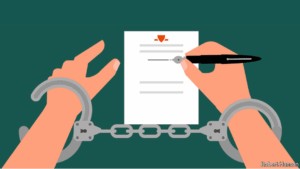
Photo Citation: Robert Hanson, Illustration of man in handcuffs signing plea bargain, in The Troubling Spread Of Plea-Bargaining From America To The World, The Economist (Nov. 9, 2017), https://www.economist.com/international/2017/11/09/the-troubling-spread-of-plea-bargaining-from-america-to-the-world.
[1] U.S. Const. amend. VI.
[2] See Am. Bar Ass’n Crim. Just. Section, Plea Bargain Task Force Report, at 14 (Feb. 22, 2023), https://www.americanbar.org/content/dam/aba/administrative/criminal_justice/reports/plea-bargain-tf-report.pdf.
[3] See Nat’l Ass’n of Crim. Def. Lawyers, Jury Trial, https://www.nacdl.org/Landing/Vanishing-Trials (last visited Feb. 1, 2026).
[4] See Am. Bar Ass’n Crim. Just. Section, Plea Bargain Task Force Report, at 17 (Feb. 22, 2023), https://www.americanbar.org/content/dam/aba/administrative/criminal_justice/reports/plea-bargain-tf-report.pdf.
[5] See id.
[6] See id.
[7] See Nat’l Ass’n of Crim. Def. Lawyers, The Trial Penalty: The Sixth Amendment Right to Trial on the Verge of Extinction and How to Save It, at 6 (2012), https://www.nacdl.org/getattachment/95b7f0f5-90df-4f9f-9115-520b3f58036a/the-trial-penalty-the-sixth-amendment-right-to-trial-on-the-verge-of-extinction-and-how-to-save-it.pdf.
[8] See Norman L. Reimer & Martín Antonio Sabelli, The Tyranny of the Trial Penalty: The Consensus that Coercive Plea Practices Must End, 31 Fed. Sent’g Rep. 215, 217 (Apr./June 2019), https://www.jstor.org/stable/26854373.
[9] See John S. Baker & Richard A. Bierschbach, Weaponizing Justice: Mandatory Minimums, the Trial Penalty, and the Purposes of Punishment, 31 Fed. Sent’g Rep. 309, 309 (2019), https://www.jstor.org/stable/26854386.
[10] See id. at 312.
[11] See Am. Bar Ass’n Crim. Just. Section, Plea Bargain Task Force Report, at 15 (Feb. 22, 2023), https://www.americanbar.org/content/dam/aba/administrative/criminal_justice/reports/plea-bargain-tf-report.pdf.
[12] See John S. Baker & Richard A. Bierschbach, Weaponizing Justice: Mandatory Minimums, the Trial Penalty, and the Purposes of Punishment, 31 Fed. Sent’g Rep. 309, 312 (2019), https://www.jstor.org/stable/26854386.
[13] See Norman L. Reimer & Martín Antonio Sabelli, The Tyranny of the Trial Penalty: The Consensus that Coercive Plea Practices Must End, 31 Fed. Sent’g Rep. 215, 21 (Apr./June 2019), https://www.jstor.org/stable/26854373.
[14] Id.
[15] See Innocence Project, Why Are People Pleading Guilty to Crimes They Didn’t Commit (Nov. 25, 2015), https://innocenceproject.org/news/why-are-people-pleading-guilty-to-crimes-they-didnt-commit/.
[16] See Norman L. Reimer & Martín Antonio Sabelli, The Tyranny of the Trial Penalty: The Consensus that Coercive Plea Practices Must End, 31 Fed. Sent’g Rep. 215, 219 (Apr./June 2019), https://www.jstor.org/stable/26854373.
[17] See Am. Bar Ass’n Crim. Just. Section, Plea Bargain Task Force Report, at 14 (Feb. 22, 2023), https://www.americanbar.org/content/dam/aba/administrative/criminal_justice/reports/plea-bargain-tf-report.pdf.
[18] Id.
[19] Id.
[20] See Bordenkircher v. Hayes, 434 U.S. 357, 365 (1978).
[21] Id.
[22] Id. at 358.
[23] Id.
[24] Id.
[25] Id. at 359.
[26] Id. at 364.
[27] See Am. Bar Ass’n Crim. Just. Section, Plea Bargain Task Force Report (Feb. 22, 2023), https://www.americanbar.org/content/dam/aba/administrative/criminal_justice/reports/plea-bargain-tf-report.pdf.
[28] See id.
[29] Id. at 17.
[30] Id.
[31] Id.
[32] See Office of the Commw. Att., Norfolk, Plea Agreement Philosophy, Policies, and Procedures (Mar. 21, 2022), https://www.norfolk.gov/DocumentCenter/View/70948/Norfolk-Commonwealths-Attorneys-Office-Plea-Philosophy-Policies-and-Procedures-03-21-2022.
[33] See id. at 3.
[34] See id. at 3-4.
[35] See Am. Bar Ass’n Crim. Just. Section, Plea Bargain Task Force Report, at 6 (Feb. 22, 2023), https://www.americanbar.org/content/dam/aba/administrative/criminal_justice/reports/plea-bargain-tf-report.pdf.
5 thoughts on “When “Choice” is Not a Choice: The Trial Penalty’s Grip on Jury Trials”