
Written By Emily Henderson L’27
The One Big Beautiful Bill Act’s (“OBBBA”) changes to federal student loan limits are set to take effect on July 1, 2026.[1] These changes mark a drastic departure from current student loan borrowing regulations and have created uncertainty among prospective borrowers and higher education institutions alike. While these changes have been framed as efforts to curb federal spending and address concerns about the student debt crisis, their broader effect is to disproportionately undermine access to graduate and professional education for students from historically underrepresented and low-income backgrounds.[2]
Further, because the OBBBA provides a higher annual borrowing limit for professional students than for graduate students, there has been growing concern about the Department of Education’s list of which degrees qualify as “professional.”[3] The list does not include many essential professions such as nursing, education, accounting, and physical therapy.[4] The Department of Education has attempted to downplay the distinction in a “Myth vs. Fact” article, stating that the definition of a “professional degree” is an internal definition used to distinguish among the programs that qualify for higher loan limits and has no bearing on whether a program is considered professional in nature or not.[5] While this may be true, it does not change the fact that students pursuing advanced degrees in these fields now face a barrier that did not exist before the OBBBA’s new student loan limits.
Comparing Current and New Loan Limits
Currently, all graduate and professional students are eligible to take out $20,500 in Unsubsidized Direct Loans with an aggregate limit of $138,500.[6] The aggregate limit includes all federal loans received for both undergraduate and graduate studies.[7] The average cost for a two-year master’s degree in 2025 is $62,820.[8] Because the annual unsubsidized loan limit often does not cover a student’s full cost of attendance for these programs, Graduate PLUS loans exist to close that gap by allowing students to borrow up to their school’s total cost of attendance.[9] Graduate PLUS loans do not have an explicit aggregate limit for all students. Instead, the maximum amount a student may borrow is “the cost of attendance (determined by the school) minus any other financial assistance [the student] receive[s].”[10]
The OBBBA changes these requirements drastically. First, the Act imposes new annual limits of $20,500 for students in graduate programs and $50,000 for students in professional programs.[11] Second, the Act sets new aggregate limits for graduate students at $100,000 and new aggregate limits for professional students at $200,000.[12]
Grad PLUS loans were eliminated entirely through the OBBBA, making these new limits especially daunting.[13] Most graduate students typically borrow loans in amounts above those that the new proposed limits will allow.[14] Without PLUS loans as an option, students will no longer be able to borrow up to their full cost of attendance in federal loans. Further, students often use PLUS loans to cover their living expenses while in school.[15] The OBBBA does not include future adjustments to loan limits, meaning the limits will decrease in value with inflation, ultimately leading to decreased affordability. This could lead to more reliance on the private student loan market, students foregoing certain programs in favor of more affordable options, or even students choosing to forego pursuing advanced degrees altogether.[16]
The Higher Education Act of 1965 expanded access to higher education by expanding the federal student loan program.[17] Prior to those expansions, only a privileged few had access to a full range of educational opportunities.[18] Opponents of the OBBBA recognize that the recent increase in graduate and professional student borrowing warrants “careful consideration” and argue that capping federal student loans is not the way to remedy the student debt crisis.[19]
In contrast, some proponents of the OBBA argue that the existence of Graduate PLUS loans provides incentive for schools to artificially increase tuition prices.[20] However, research has found a lack of strong empirical support for this statement.[21] There is also no evidence to suggest that capping student loans will result in schools reducing their tuition costs.[22] Further, the allotted cost of attendance for graduate and professional programs covers more than just tuition; cost of attendance also encompasses living expenses like housing and food.[23] With inflation on the rise in both of these categories, PLUS loans serve as a safeguard to allow students to sustain themselves while they pursue their education.[24]
Disproportionate Effects of Loan Limits on Low-Income Populations
While there may be no evidence that student loan limits will serve to reduce tuition costs, there is significant evidence that suggests these new loan limits will act as a barrier to access advanced education, specifically for underrepresented, low-income populations.[25] Private student loans replacing PLUS loans means students will be facing higher interest rates and less repayment flexibility.[26] Estimates show that the average PLUS borrower who replaces their entire loan with a private option would pay an additional $10,885 just in interest.[27]
Increased reliance on the private market also runs the risk of completely shutting out low-income students who do not have a co-signer.[28] Private loans, unlike federal loans, rely on metrics such as credit history and income for approval.[29] Students and co-signers from low-income populations often do not meet the stringent requirements of the lending company and are left without adequate funding options beyond federal loans.[30]
Without access to federal loans, many professions will likely see less-diverse workforces.[31] For example, most medical students already come from the upper 40% of family income.[32] Removing access to loans will likely result in even fewer applicants from low- and middle-income families because they simply cannot bear the burden of the cost of attendance.[33] In addition, the proposed loan limits fall well below the cost of attendance for many graduate and professional programs.[34] Students who rely on federal aid to fund their education will be effectively shut out from pursuing their passions.[35]
The OBBBA’s proposed loan limits will have little effect on those who can rely on family to fund their education or qualify for private loans, but they will egregiously affect students who benefit the most from the expanded federal loan system enacted by the Higher Education Act of 1965. Even those who qualify for private loans will face exorbitant interest rates and a lack of flexible repayment plans.[36] The proposed limits will create potentially insurmountable barriers to obtaining an advanced degree, resulting in a less diverse workforce and a less educated society that will be detrimental to the country as a whole.[37]
—
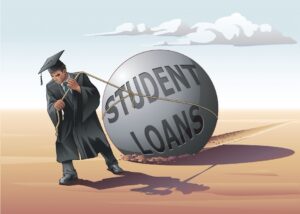
Image of a student in graduation regalia struggling to drag a boulder etched with the words “student loans” behind him, in Richard K. Vedder, Eliminate or Radically Restructure Federal Student Loans, THE JAMES G. MARTIN CTR. FOR ACAD. RENEWAL (Sep. 16, 2020) https://jamesgmartin.center/2020/09/eliminate-or-radically-restructure-federal-student-loans/.
[1] H.R. 1, 119th Cong. § 81001 (2025).
[2] Monica Konaté, From Aspiration to Limitation – The Impact of Graduate Loan Caps, AccessLex Inst. (Sept. 4, 2025) https://www.accesslex.org/news-tools-and-resources/aspiration-limitation-impact-graduate-loan-caps.
[3] Professional Degrees and Student Loans, THE CONF. BD. (Dec. 3, 2025) https://www.conference-board.org/research/CED-Newsletters-Alerts/professional-degrees-and-student-loans.
[4] Jasmine Laws, Full List of Degrees Not Classed As ‘Professional’ by Trump Admin, Newsweek (Nov. 26, 2025 at 3:31 AM EST) https://www.newsweek.com/full-list-degrees-professional-trump-administration-11085695.
[5] Myth vs. Fact: The Definition of Professional Degrees, U. S. Dep’t of Educ. (Nov. 24, 2025) https://www.ed.gov/about/news/press-release/myth-vs-fact-definition-of-professional-degrees.
[6] Direct Subsidized and Direct Unsubsidized Loans, Federal Student Aid https://studentaid.gov/understand-aid/types/loans/subsidized-unsubsidized#how-much (last visited Dec. 1, 2025).
[7] Direct PLUS Loans for Graduate or Professional Students, Federal Student Aid https://studentaid.gov/understand-aid/types/loans/plus/grad (last visited Dec. 1, 2025).
[8] Melanie Hanson, Average Cost of a Master’s Degree, Education Data Initiative (Nov. 23, 2024) https://educationdata.org/average-cost-of-a-masters-degree.
[9] Penny Redlin, What to Do Now That Grad PLUS Loans are Gone, Edvisors (July 14, 2025) https://www.edvisors.com/blog/big-beautiful-bill-eliminates-grad-plus-loans/.
[10] Direct PLUS Loans for Graduate or Professional Students, Federal Student Aid https://studentaid.gov/understand-aid/types/loans/plus/grad (last visited Dec. 1, 2025).
[11] H.R. 1, 119th Cong. § 81001 (2025).
[12] Id.
[13] Id.
[14] Jason Cohn, How New Federal Student Loan Limits Could Affect Borrowers, Urb. Inst. (July 24, 2025) https://www.urban.org/urban-wire/how-new-federal-student-loan-limits-could-affect-borrowers.
[15] Id.
[16] Id.
[17] Issue Brief: Graduate Student Loans: How Caps Threaten Access, AccessLex Inst. at 2 (Sept. 4, 2025) https://www.accesslex.org/tools-and-resources/graduate-student-loans-how-caps-threaten-access.
[18] Id.
[19] Id. at 3.
[20] Id. at 7
[21] Id.
[22] Id. at 8.
[23] Id. at 7.
[24] Id. at 7.
[25] Id. at 8.
[26] Adam S. Minsky, Major Student Loan Limits Set to Take Effect, With Big Implications for Borrowing, Forbes (Nov. 24, 2025 at 12:19 PM EST) https://www.forbes.com/sites/adamminsky/2025/11/24/major-student-loan-limits-set-to-take-effect-with-big-implications-for-borrowing/.
[27] Id.
[28] Maria Carrasco, Experts Discuss How New Loan Limits Will Impact Students, Nat’l Ass’n of Student Fin. Aid Adm’rs (Oct. 16, 2025) https://www.nasfaa.org/news-item/37467/Experts_Discuss_How_New_Loan_Limits_Will_Impact_Students.
[29] Your Guide to Private Student Loans, CollegeRaptor (Apr. 9, 2025) https://www.collegeraptor.com/paying-for-college/articles/student-loans/need-know-private-student-loans/?st_source=ai_mode.
[30] Id.
[31] Joanne Kenen, New Limits on School Loans Could Narrow Physician and Nurse Pipeline, Educators Warn, Nat’l Pub. Radio (Nov. 25, 2025 at 5:00 AM ET) https://www.npr.org/sections/shots-health-news/2025/11/25/nx-s1-5619731/medical-nursing-school-loan-limits.
[32] Id.
[33] Id.
[34] Issue Brief: Graduate Student Loans: How Caps Threaten Access, AccessLex Inst. at 12 (Sept. 4, 2025) https://www.accesslex.org/tools-and-resources/graduate-student-loans-how-caps-threaten-access.
[35] Id.
[36] Adam S. Minsky, Major Student Loan Limits Set to Take Effect, With Big Implications for Borrowing, Forbes (Nov. 24, 2025 at 12:19 PM EST) https://www.forbes.com/sites/adamminsky/2025/11/24/major-student-loan-limits-set-to-take-effect-with-big-implications-for-borrowing/.
[37] Id.
2 thoughts on “How the New Federal Student Loan Limits Widen the Higher Education Accessibility Gap”